Scientific notation is a way of expressing very large or very small numbers in a more manageable form. It consists of a number between 1 and 10, multiplied by a power of 10. This notation is commonly used in science, engineering, and mathematics to simplify complex calculations and make them easier to understand. Operations with scientific notation are essential in many fields, including physics, chemistry, and biology.
Performing operations with scientific notation can seem intimidating at first, but with practice, it becomes straightforward. The key is to understand the rules of exponentiation and how to apply them when adding, subtracting, multiplying, or dividing numbers in scientific notation. With the right skills and knowledge, you can tackle even the most complex calculations with confidence. To help you get started, we’ve put together a comprehensive guide to operations with scientific notation, along with a worksheet and answers to help you practice.
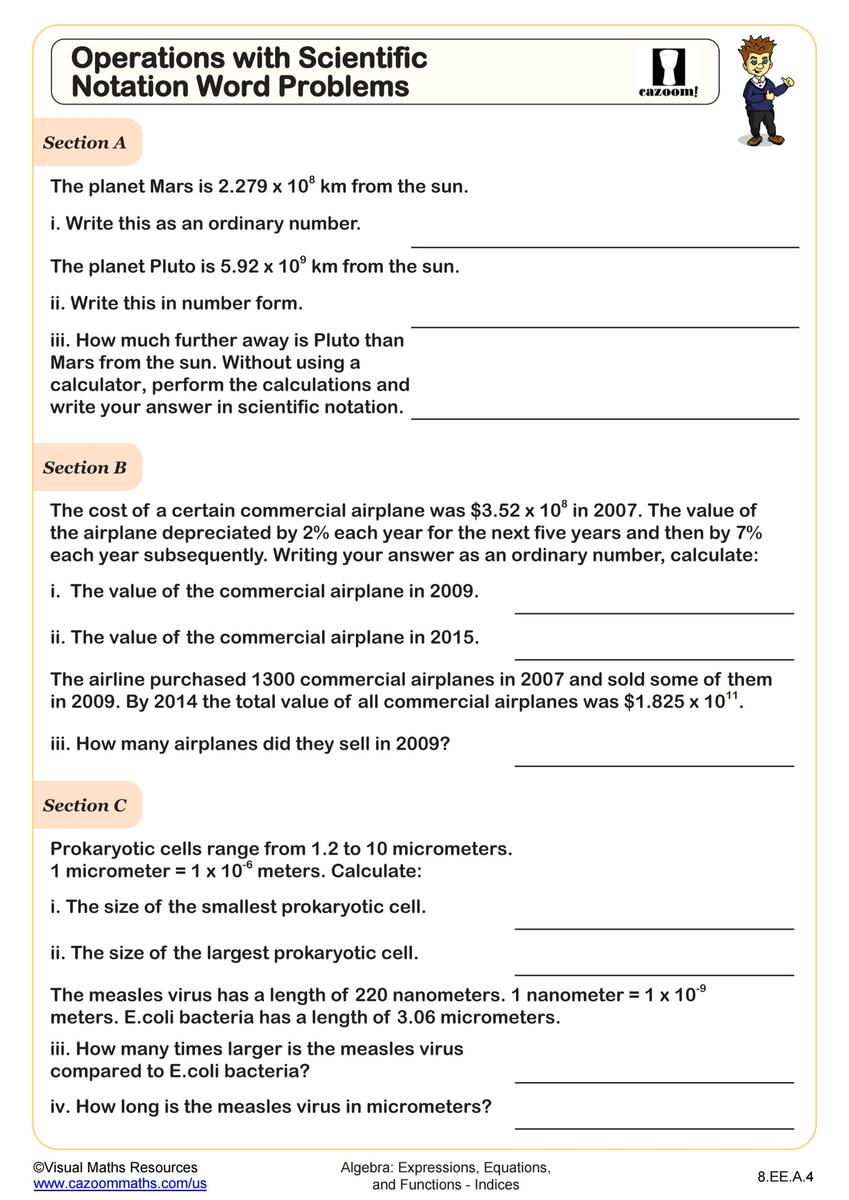
Operations With Scientific Notation Word Problems Worksheet 8th Grade PDF Worksheets Cazoom Math
Understanding Scientific Notation
To understand scientific notation, you need to know how to read and write numbers in this format. A number in scientific notation consists of a coefficient (a number between 1 and 10) and an exponent (a power of 10). For example, the number 456 can be written in scientific notation as 4.56 x 10^2. Understanding how to convert numbers to and from scientific notation is crucial for performing operations with these numbers.
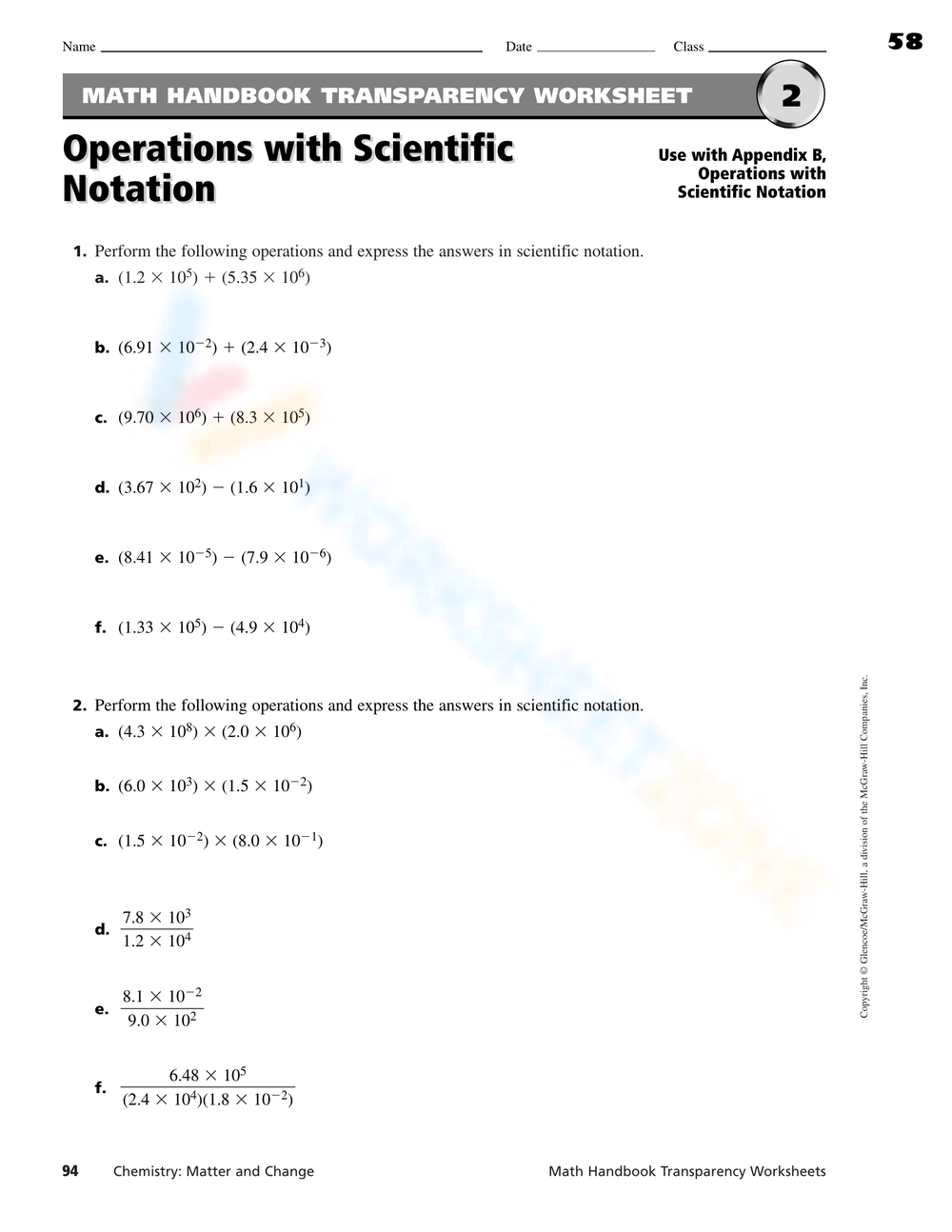
Scientific Notation Operations Practice Worksheet
Adding and Subtracting with Scientific Notation
When adding and subtracting numbers in scientific notation, you need to make sure that the exponents are the same. If they are not, you need to adjust the coefficients and exponents accordingly. For example, to add 2.5 x 10^3 and 3.7 x 10^2, you need to convert the second number to have an exponent of 3, resulting in 0.37 x 10^3. You can then add the coefficients to get 2.87 x 10^3.
Multiplying and Dividing with Scientific Notation
Multiplying and dividing numbers in scientific notation is relatively straightforward. When multiplying, you multiply the coefficients and add the exponents. For example, to multiply 2.5 x 10^3 and 3.7 x 10^2, you multiply 2.5 and 3.7 to get 9.25, and add 3 and 2 to get 5, resulting in 9.25 x 10^5. When dividing, you divide the coefficients and subtract the exponents. For example, to divide 2.5 x 10^3 by 3.7 x 10^2, you divide 2.5 by 3.7 to get 0.676, and subtract 2 from 3 to get 1, resulting in 0.676 x 10^1.
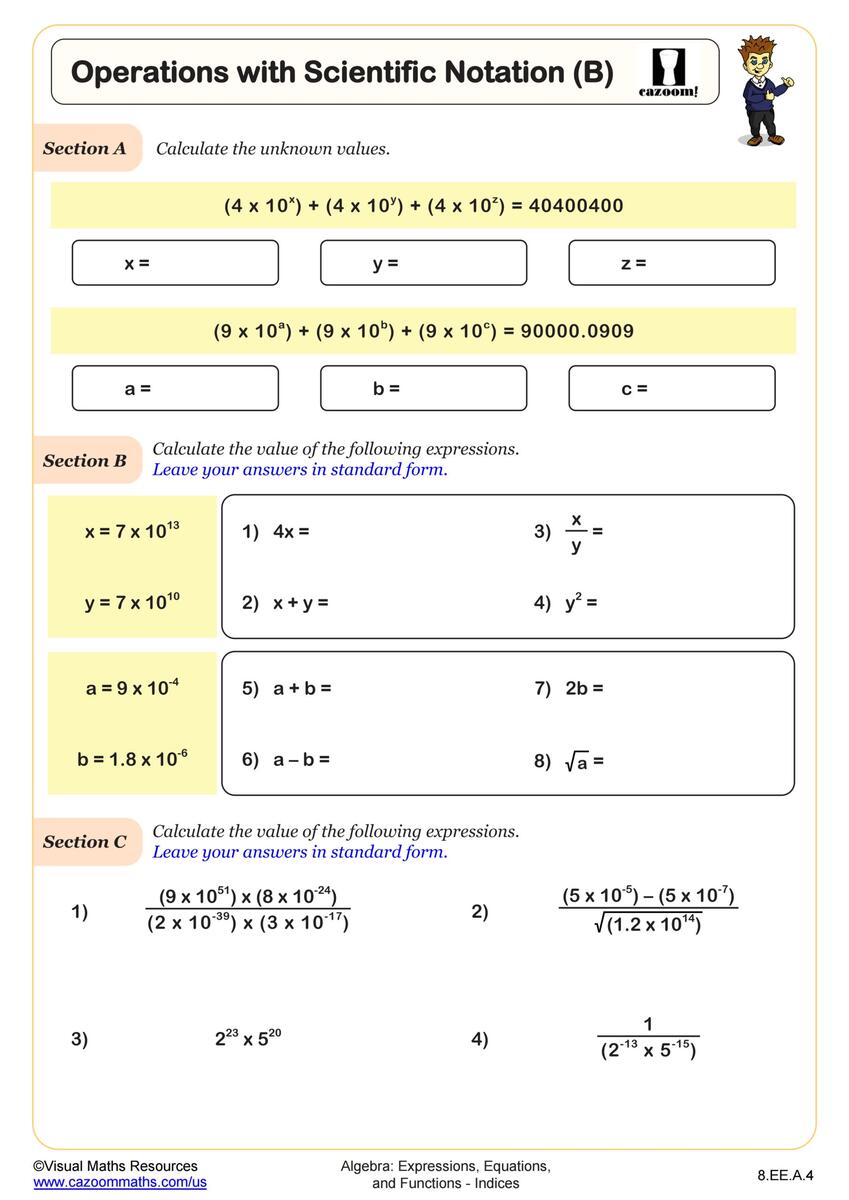
Operations With Scientific Notation B Worksheet PDF Printable Algebra Worksheet Cazoom Math
To practice your skills and reinforce your understanding of operations with scientific notation, be sure to download our Operations With Scientific Notation Worksheet Answers. This worksheet provides a range of exercises and problems to help you master adding, subtracting, multiplying, and dividing numbers in scientific notation. With practice and patience, you’ll become proficient in performing operations with scientific notation and be able to tackle complex calculations with ease.
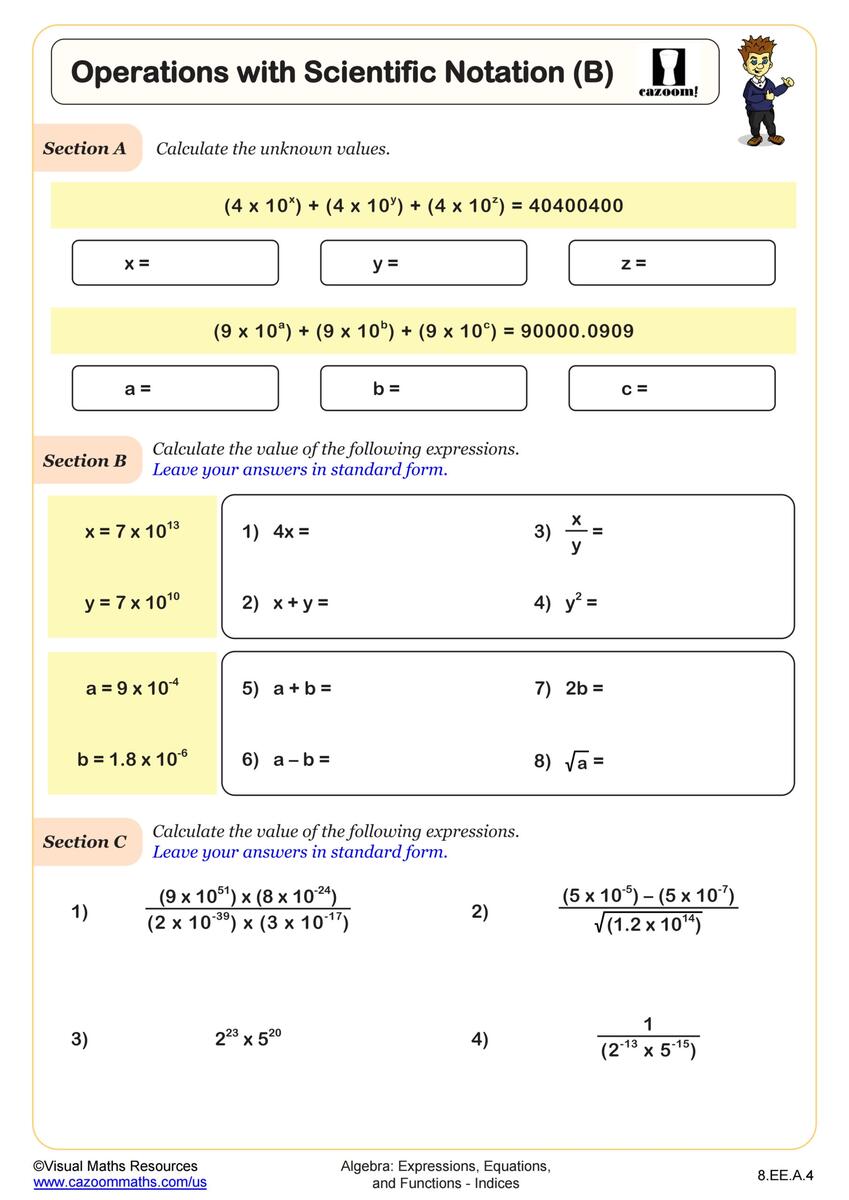
Operations With Scientific Notation B Worksheet PDF Printable Algebra Worksheet Cazoom Math
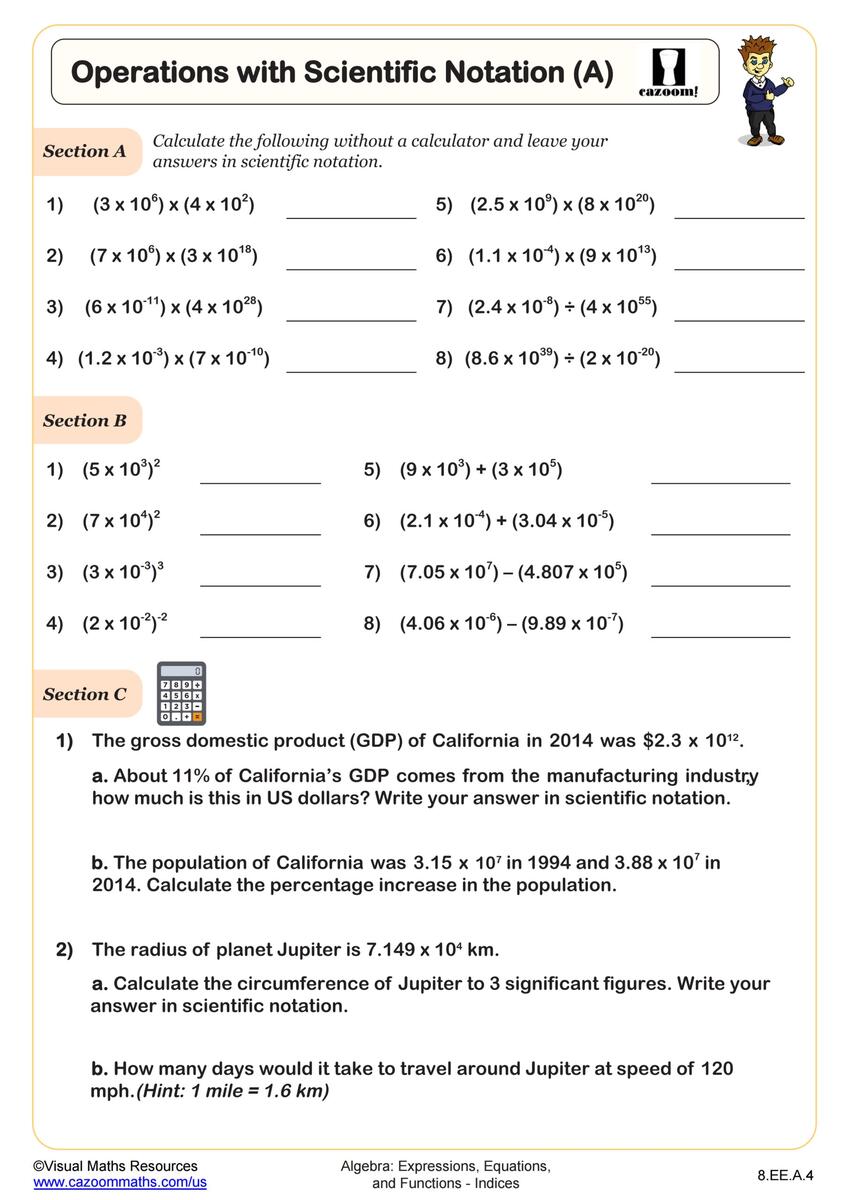
Operations With Scientific Notation A Worksheet Fun And Engaging 8th Grade PDF Worksheets Cazoom Math